Tuesday, May 7, 2013

Bunnies!!!!

What's up, Doc?
Lately I've been writing a lot of blogs on animals other than hamsters. Well and friend and coworker asked me for some tips for her two bunnies. So....Here is a blog on proper rabbit care!

What Is A Rabbit?
A rabbit is a small mammal that makes a wonderful pet/friend! Rabbits actually rank fourth in North America as pets. (After cats, dogs, and birds.) When most people think of a rabbit, they think of a tall grey and white rabbit, standing upright, munching on a carrot, and asking "What's up, Doc?" shortly followed by some sarcastic remark. Yes, I'm speaking of Bugs Bunny. But a Rabbit is so much more than most Loony Tunes fans think! Bunnies are very intelligent, strong, and fast. Their speed is in their back legs. (Did you know that a rabbit can actually kick it's back legs so hard, it can break it's own back? Don't worry, your bun won't do this for no reason. It would only happen if they were trying to escape the jaws of a predator in the wild and made a wrong move!)

Ever noticed that many rabbits look different? Just like dogs, there are many different breeds of bunnies. There are even Rabbit Shows! Most of the buns you would buy from a pet shop are mutts. The most popular pet breeds are Dutch, Lop, Rex, Mini Rex, Satin, Mini Satin, and Netherland Dwarf. These bunnies may have short or long (Angora) fur and it may be coarse or silky. Their ears may stand straight up or may hang down to the sides of their head (Lop eared).

Bunnies usually love other bunnies and can often be housed in same sex pairs or groups, as long as there is enough cage room. But I stress that these buns be of the same sex to prevent reproduction. A rabbit's gestation period is 30 days and litters typically have 5-8 young. Babies are called kittens or kits. Please be mindful of this and leave breeding to the professionals!

Is A Rabbit The Right Pet For Me?
Before bringing home your furry friend there are some things to consider.
*Do you live in a rent house or an apartment where you have a landlord? If so, check with them first to make sure small animals are allowed in your home. There may be a security deposit and/or additional rent required. Make sure your budget will allow for this.
*Do you have time in your schedule to properly care for this little bundle of joy?
*Do you have room in your budget for all of it's expenses?
*Do you have a safe area in your home for a roomy cage?
*Do you have any other pets or small children that may harm or scare the Rabbit?
*Does anyone in your home have an allergy to fur? If so, they may be allergic to buns.
****Are you only adopting a bunny as an Easter gift for a child? If so, stop and rethink what you are doing! Many rabbits are sold as Easter gifts, but soon after the holiday passes many people grow tired of their pet or find out the care and/or expense of a bunny is too much for them and try to get rid of them. Easter rabbits will often end up in shelters, abandoned on the side of the road, or released into the wild. Please read on and think carefully before taking on the responsibility of an Easter bunny!


Bun-Bun-Must-Haves!
Rabbits can be amazing companions, but you have to provide the right things for them to be happy and healthy!

Cage/Hutch: Bunnies need plenty of space to run around and play. A rabbit's cage/hutch should be relatively large. Your bun should be able to sit up on his/her hind legs, with his/her ears sticking straight up without touching the roof of the cage. If his/her ears touch the hutch is too small. Another thing to conciser heightwise, is that bunnies hop. Your friend should be able to hop around comfortable without any part of it's body touching the hutch roof. Lengthwise and widthwise, the cage should be long enough so that your rabbit can lay down and completely stretch out without touching the walls. If it cannot do this, the hutch is too small. Keep in mind, the cage will have more things in it aside from your baby bun! Of course, your hutch should be as large as you can afford and have room for. Many people build their own cages/hutches, as it is cheaper and they can build them the way they want them. Cages/hutches can be indoor or outdoor. though many people have both. If you are housing multiple rabbits in the same cage, they should all be able to stretch out completely without any part of their bodies touching each other or the cage walls. Overcrowding a cage can be dangerous. Your bunnies can become irritable, ill, fight each other, stressed, and much more.
Free Run: Many people let their rabbits loose in their house or fenced in backyard like a cat. Rabbits can can potty trained relatively easy, so this is possible. Remember that other pets can scare or harm the bunny so be aware of this.
House: You will need to rabbit proof your home before letting your baby bun run free. Make sure there is nothing your rabbit can get caught on or stuck in. Short trash cans should be picked up or have lids on them. Some people block off the bottoms of beds, sofas, ect. so prevent their bunnies from hiding under them. This is not necessarily, so long as the underside is kept clean and tidy. Make sure to monitor them in areas with rugs or carpet, as they might try to chew them. This goes for fabric covered furniture and anything else they can get their ever-growing teeth on. Rabbits, just like most other small animals, have teeth that never stop growing and chew on almost anything, so keep everything you don't want shredded out of their reach. This brings me to the wires. We live in a world that is drowned in technology and we all have homes full of wires! Make sure your baby bun does not chew on any wires, as they can get electrocuted  as well as cost you your TV wires and cell phone charger. You can approach this in multiple ways. Pick up as many of the wires as possible. You can also buy clear tubing from Home Depot of other hardware stores to encase the wires in to prevent chewing. And lastly, you can completely block off the backs of entertainment centers and other areas.
Backyard: If your going to let your bunny run loose in your yard you should make sure it is safe! Make sure there are no wild animals or other pets that could frighten or cause harm to your bun. Make sure there are no holes in your fence and there are no dangerous objects in the yard. Be sure that any of the plants in your yard are not poisonous to your rabbit, as they will try to eat them. And lastly, make sure no pesticides have been used on the grass or plants.

Food: How many times have you heard someone refer to a salad as "Rabbit Food"? Did you know that's technically wrong?
*Hay: Rabbits need an unlimited amount of grass hay. Offer fresh grass hays such as timothy, oat, coastal, brome, Bahia or wheat.
*Pellets: A quality commercial brand of rabbit pellets is also essential for your baby bun's heath.
*Fresh fruits and vegetables can be offered, but should not make up too much of the bun's diet. Uneaten fruits and veggies should be removed after 24 hours. Most rabbits enjoy

 broccoli, dark leaf lettuces, kale, parsley, carrots (with tops!), endive, escarole, dill, basil, mint, cilantro, culantro, spinach, tomato, celery (cut up into 1" pieces, to avoid problems with the tough strings getting stuck on the molars!).


Food Bowl/Water Bottle: You'll need a fairly large bowl for your baby bun's food. A ceramic bowl is hard t over turn and chew proof. If offering treats, fresh fruits/veggies, a separate bowl should be provided. Hay racks and spinners can be bought to keep the cage floor clean and keep the hay itself clean. Your rabbit will need plenty of water, which should be provided from a water bottle.

House: Rabbits can get stressed sometimes, so they need someplace to hide in! There are many options for this, from plastic igloos to wooden boxes. Rabbits love to burrow so fill their houses with aspen wood bedding, paper bedding, and/or hay.

Toys: Rabbits love to chew on, and push around toys. Balls, toilet paper tubes, ferret toys, cat toys, anything they can easily push around. There is a wide variety of rabbit toys to choose from. Most of them are chewing materials, since a rabbit's teeth never stop growing. Bunnies do not need an exercise wheel or saucer because their cage/habitat should be large enough that they can run around and get the exercise they need. (Though a rabbit running on a wheel is not completely unheard of.) Rabbits are very smart animals and can be trained to do tricks and run obstacle courses. In fact, most rabbits can play fetch and hide and seek with you!

Stress Alert!
Rabbits often become stressed due to a variety of factors, that can actually make them ill! Baby Bun owners should be well aware of this. When rabbits become too stressed they may stop eating and become unhealthy and irritable. If you think your bun is too stressed try to figure out what is bothering him/her and solve the problem. You should also contact a vet if they seem unhealthy.
Things that can put a rabbit under stress are (but are not limited to):
Other animals (sometimes including other bunnies), Children, Loud noises, Desire to mate, Diet/food change, New habitat, Rough handling, No place to hide.

Actually, I had two rabbits years ago when I was younger. Sugar and Flour. I loved those little girls so much!  I'll write a blog about them one day. Before we moved into our apartment I was seriously considering adopting another bunny, but decided against it because I was worried I wouldn't be able to give him/her enough room to play in.

Hope you all enjoyed this!
-Tracy

Tuesday, April 16, 2013

Hamster Hunt! Which Hamster is for Me?

One of the most commonly asked questions about hamsters is which one makes for the best pet. I know I've gone through this, as has the rest of the population of curious hamster-parents-to-be, and it can be just as frustrating as it is fun. Some people will actually stress about this so much that they decide not to adopt at all! You shouldn't get discouraged. While which species of hamster to get can be confusing, it doesn't have to be, and I'm here to make it as simple as possible!

Hamster Species
Of all of the species of hamsters (Yes, there is a lot) only 5 are widely kept as pet in the USA. (What this basically means is PetCo and Petsmart only sell 5 species....And for good reason) These 5 species are Syrian hamsters, Djungarian dwarf hamsters, Roborovski dwarf hamsters, Campbells dwarf hamsters, and Chinese dwarf hamsters. Each is unique in their own way, just as people are.

All Hamsters....
  • Are Crepuscular. This means that they are most active (though not limited to) in the mornings and evenings.
  • Have teeth that never stop growing. So chewing materials must be supplied.
  • Chew anything they can get their teeth on. Because of this, they need to be housed in a safe, sturdy, chew-proof habitat.
  • Need to run. Make suren to provide them with a running wheel. They are avid exercisers.
  • Can be tamed. When you first bring a hamster home they might not be too friendly, but with some tender loving care, even the wildest ham ham can become your new best friend.
  • Cost money. The initial set up of owning a hamster does cost a bit (buying a cage, food bowl, water bottle, house, food, chews, treats, bedding, and the hamster itself) but owning a hamster can be relatively inexpensive. (Unless you spoil them the way I do!) But do keep in mind you never know what may happen and you may need to pay your local vet a visit, which is where it can get very expensive.

Most Hamsters....
  • Are best kept alone. Even though they get along while they are young, hamsters will often grow to become territorial and will fight cage mates. Because of this, only experienced hamster parents should even attempt to house more than one hamster in a single cage. If you do attempt to keep multiple hamsters in the same cage they should each have their own wheel, food bowl, water bottle, and house. (Example: for 3 hamsters=3 wheels) Hamsters housed together should be closely monitored though and an extra cage will be necessary in case they need to be separated. It is true that many dwarf hamsters enjoy and can be housed together, but there is always a chance they will fight which is why I stress that first time hamster parents should only get a single hamster. If hamsters are housed together they should be the same sex to prevent breeding. (FUN FACT: A hamster's gestation period ranges from 16 to 30 days depending on the species and and single litter can have up to 13 pups.) Hamsters multiply very fast and breeding should be left to experienced hamster parents. (Also hamsters of different species should NEVER be housed together.)


Syrian Hamster​​​
​Scientific Name: ​​​Mesocricetus auratus
​Alternative Names: ​​​Golden Hamster, Fancy ​Hamster, Teddybear Hamster, Standard Hamster
​Native To: Syria
Adult Size: 5-6"
Life Span: 2-3 years
About:​ Syrian Hamsters are the widest kept hamsters in the US. They are the most known of hamsters and most available. Due to their larger size, and ease of taming, they make for excellent starter hamsters. Syrians are a more hardy species of hamster, and do not get sick easily. They are fairly easily handled by both adult and child hands. They come in many different colors and there is also a long haired species. Many pet shops offer unusually marked hamsters as "Fancy Hamsters" and sell them for nearly double the price of normal Syrian Hamsters. Syrian hamsters are solitary hamsters and should never be housed together. (Unless it is a male and female the owner intends on breeding.)

​​Dwarf Russian Djungarian Hamster​
Scientific Name: Phodopus sungorus
Alternative Names: Winter White Hamster, Siberian Hamster
Native To: Asia
Adult Size: 3-5"
Life Span: 1-2 years
About:​ Djungarian hamsters are thought to be one of the most naturally friendly species of hamster, making taming them rather simple. However, at nearly half the size of Syrian hamsters, they are much harder to handle for children. Their smaller size makes them faster and more active, as well as more vulnerable to clumsy hands. Winter Whites can sometimes coexist with others, but may need to be separated one day.
 Roborovski Hamster
​Scientific Name: Phodopus roborovskii
Alternative Names: Robos, Robs, Dessert Hamsters
Native To: Asia
Adult Size: 1.5-3"
Life Span: 2-3 years
About:​ Roborovski Hamsters are the smallest and fastest of all hamsters. This makes them a challenge to tame and handle. They are not recommended for starter hamsters or for young children. They have been said to run the equivalent of four human marathons per night on average, so, you guessed it, if one gets loose your going to have a field day trying to catch it! Robos are great little things to sit and observe. Most Robo hamsters enjoy living in groups of 2 to 5, but due to the chance of fighting parents of multiple hamsters must be prepared to separate and house them separately.
 ​​Dwarf Campbells Russian Hamster​
Scientific Name: Phodopus campbelli
Alternative Names:Cam
Native To: Asia, China
Adult Size: 2-3"
Life Span: 2-3 years
About:​ Campbell Hamsters are closely related to Djungarian Hamsters, and the two species are very often confused with one another. They are relatively easy to tame, though not quite as easy as their close cousins, the Djungarian hamsters. These hamsters are not easily handled by small, clumsy hands, and may feel threatened. There small size makes them fast and active. Some pet stores, such as PetCo, do not have them listed as Campbells, but just Dwarf Hamsters. This makes them seem more rare than they actually are. Many Campbells can happily coexist in pairs or groups of three, but are not exempt from the possibility of fights.
Dwarf Chinese Hamster
​Scientific Name: Cricetulus griseus
Alternative Names: Chin
Native To: Asia, China
Adult Size: 4"
Life Span: 3-5 years
About: ​When young, Chinese Dwarf Hamsters are quite nervous but grow to be very gentle and calm. Compared with other hamsters they have a long, thin build and a relatively long tail. Because of this, some people may confuse them with mice. Their small size makes them quick, and harder for children to hold. They are great for watching. Some US states such as California, regard Chinese Hamsters as pests and a special permit is required to own, breed and sell them. In other states such as New Jersey they are classed as exotic animals and a permit is also required to own them. Many Chinese dwarfs can live together in small groups.

With That Said....
I will break hamsters down into two categories. Syrian and Dwarf. (Syrian and....The rest)
  • Syrian hamsters: These larger, easily tamed hamsters make for great starter hamsters. They are cute, little things that are relatively easy to care for. They are solitary creatures and will not need a roommate. If you have a child I would highly suggest a Syrian hamster due to their ease of handling and taming. Once a Syrian is tamed, it will stay tamed for the remainder of it's life.
  • Dwarf hamsters: These smaller, faster hamsters can be a bit more of a challenge to handle and tame and are not recommended for children. Especially Robos and Chinese dwarfs, which are best kept in large, glass tanks and observed. However, dwarf hamsters are cute, active, and can be a lot of fun to care for. Dwarf hamsters may be housed in same sex pairs or small groups but must be monitored and hamsters parents should have another cage in case separation is necessary. Dwarf hamsters, if ignored or neglected, can become wild again.

With THAT Said....
All hamsters are different and everyone has their own opinion. You may have a bad experience with one species of hamster, but a wonderful one with a different species. Only by watching, researching, and interacting with these adorable balls of fluff can you decide which one is right for you!

Also....DO NOT choose a hamster based only on HOW CUTE IT IS!
I can't tell you how many people adopt hamsters based only on their looks and end up with a bad tempered one, or a species they can not properly care for. Roborovski hamsters are a good example of this. They are tiny, adorable, and you just want to cuddle them, but they are fast and hard to tame. Many people adopt Robos and find out that they are quite a handful and end up neglecting the poor little things.

I wish everyone good luck in their hamster hunt! Until next time, guys!
-Tracy

Tuesday, April 2, 2013

Puzzle Paradise: Episode 3

****BREAKING NEWS!!****

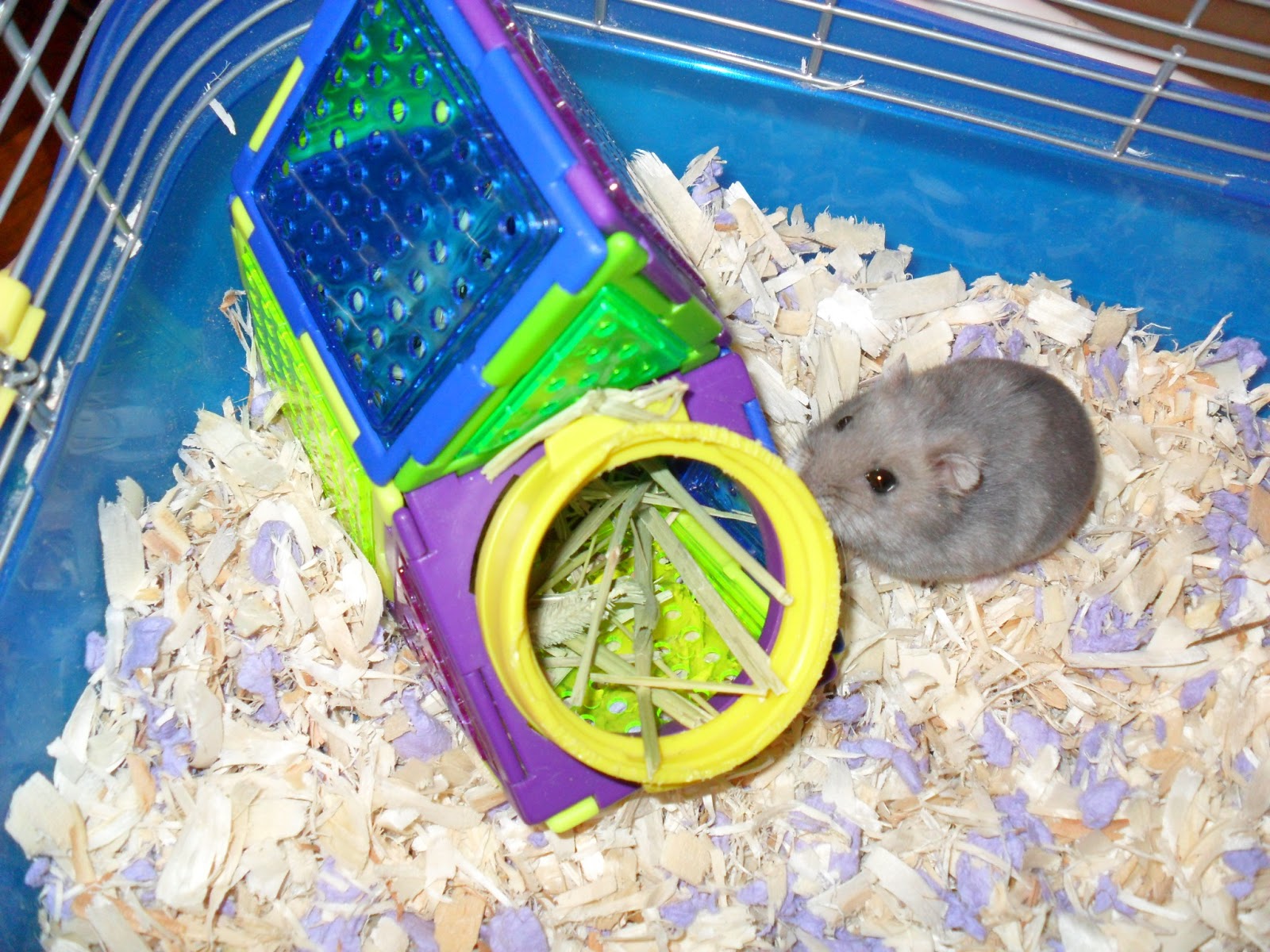
You can connect tubes to your puzzle playground sets! It takes a bit of work to pop them into place, but it works! Sasha's habitat is amazing now, and she LOVES the tubes!
This was Sasha's habitat set up last week. She seemed very happy that I found I way to introduce the tubes back into her home. She had plenty of room to burrow and a lot of things to climb on because of the tubes.

This is Sasha's current set up. She really seems to enjoy this one. She climbs all through the tubes. I'm thinking of getting another Puzzle Playground set and some more tubes. What do you guys think?
See you next time! :))
-Tracy

Wednesday, March 27, 2013

Itty Bitty Update!

Hello All! I just wanted to let everyone know how Sasha and Leela are doing!

Sasha
Sasha is doing well! She gets a bit jealous when she smells Leela on me, and even nipped my finger once, but she's ok. Right now I just cleaned their cages and she seems to be very happy with the way I set up her cage. :)) Since I put Sasha in the tank she has been even more active. Little demon just likes to work out like her mommy and daddy I guess! She adjusted to the tank very quickly and I think she likes it more than her old cage. She has a silly habit though. She piles all her bedding into one corner of the tank, then climbs on it and burrows into it. She's so silly. She also stands on her back legs and puts her hands on the glass wall and digs into it. It's super cute!
Leela
As you may know, two weeks ago my coworker asked me to tame her Robo hamster Leela. She is still very skittish, but she's making progress. It's a bit easier to hold her now. and when we walk around the room she watches us. When my coworker first brought her over she would hide all day and only come out at night when we went to sleep. Taming doesn't happen over night, but she's making great progress!


The two little hamsters have met each other. I put each of them in their exercise balls and they will often roll up to each other and smell the other through the balls. I would never actually put them together though. Well, until next time guys! I'm going to have another Puzzle Paradise episode very soon!
-Tracy

Monday, March 18, 2013

The Trick To Taming!


Hello all! It's taken awhile to get a video about taming a hamster up because I didn't want to use a hamster that is already tamed, as Sasha is. Right now, I am taming a friend's hamster. Her name is Leela. She is a Roborovski hamster. They are the smallest and fastest hamsters and this makes them harder to tame.

The Box Method
The easiest way to tame a hamster is the box method. You use a rather large box, with sides tall enough that your hamster can not climb or jump out of. Place their wheel in the box so they can run. Hamsters are nervous runners, so this is important. Also put a scoop of their bedding in the box so they have some of their own scent. Place him/her in the box and give them a few minutes to adjust to their new surroundings.

When your ready, gently scoop them up in your hands and cup them. Be careful not to squeeze them or be rough. Do not force them. Most of the time, when cupped, a hamster will either sit very still of dig into your palm. Do not be afraid. I have never been bitten while doing this (and I've done this many times), but if he/she does bite you then put them back in their cage and try again later. After you've held them for a few seconds, slowly open your hands. If your hammie sits on your hands instead of jumping off immediately  then your making some progress. Let them walk off your hands on their own, and then let them run around for a minute before repeating this. Each time you cup the hamster, hold it for just a little bit longer.

Repeat this everyday for two or three times. Keep in mind, punishment will NOT work. If your hamster isn't taming or bites you, do not raise your voice or get rough. This will just make the hamster afraid of you.

Tricks To Taming
There are some other things you can do to get your hamster used to you.
*When you clean their cage, rub their bedding on your hands so it will hold your scent.
*Talk to your hammie. Hearing your voice will help them get used to you.

Remember! A tame hamster will take treats from your hand. Once your hamster does this, pat yourself on the back because you've done a good job! :)) I hope this helps!

By the way, this is Leela.
Oh and to see a video about taming, visit my YouTube Channel.
http://www.youtube.com/watch?v=mnT3XQd-7PU
-Tracy

Wednesday, March 6, 2013

Puzzle Paradise: Episode 2

In an earlier post I introduced you guys to the idea of Puzzle Paradise episodes. I spent all of episode one doing a review on the Puzzle Playground sets. Episode two, and all that follow, will be about different things I've built with the puzzle playground sets.


I hope you enjoyed all of my creations! :)) And remember if you have any creations of your own, send them to me on facebook, or e-mail me at winryyuzu@yahoo.com. See you next time guys!
-Tracy

Tuesday, February 26, 2013

Bowling for....Bowls?

Hello everyone! How are you all doing? Today I'm going to talk about different food bowls you can use for your hamster or other small animal!

There are many different types of bowls you can use for your furry little friend. Personally, I have a LOT of bowls, but you only really need one!
To start, I store my hamster food in this plastic container. I bought it from Walmart for like $2 or $3. It holds an entire bag of food, so it's the perfect size. The lid seals tight so the food stays fresh. The three bowls to the right of the container are probably the most common food bowls. The small blue bowl is made of plastic and has a wide base so it is harder to tip over. these bowls are very cheap, but are rather small. I usually only use these bowls for treats. These bowls often come in starter kits. The light blue bowl is ceramic so it is completely chew proof and it is heavy so it's very hard to tip over. These are very good bowls and they aren't too expensive. The yellow bowl is a plastic bowl that came with a cage I bought. It is a nice size, but I don't think you can buy them separately.

There are many small animal homes that have bowls built into them. The wooden house at far left is from Petco. It cost around $5 and has a bowl on the top of it. The next three items are from a "living room" furniture set for small animals that my friend got me. I think the set costs around $12 and comes with the lamp, chair, TV, and a couch house. The lamp works ok for food, but the chair is better for treats because it is rather small. The TV isn't actually for food,  but it works for treats.


 If your going for a natural look, then a rock dish will work nicely. There technically for reptiles, but they work for ham-hams too! There rather inexpensive and are usually made of a hard plastic material.
  
This bowl is a nifty little thing! It's actually for birds. It hooks onto things by wire on the back. It is made of hard plastic. I got this bowl from Petco for $2. It is a good size for food or treats and since it hooks onto something it can't be tipped over! If you use the puzzle playgrounds, then you can hook it onto the puzzles.

You can also hook the bowl onto the bars of a wire cage. it fits on nicely.

Anyone have puzzle playground pieces? You can build a food house! Now, obviously this wouldn't work with food because of the holes, but it's great for treats and fresh fruits and veggies. It works well for Timothy hay also!

Ok now this is kind of weird, but bare with me. The wire cage I was using for Sasha was two stories that were connected by tubes. The second floor had two holes in the ground. One was meant for a tube, and the other was supposed to be covered with a wide bottom food bowl (Like the blue one I showed earlier) Instead I put a bubble cap used to block one end of a tube upside down in one of the holes and put treats in it. I wouldn't do this with food, but it was ok for treats and snacks. Sasha would often bury them. I know this is really situational, but anyone with a cage that is similar can try this.


You can also place a house over the treat bubble if you like.

There are also many other ways to give your furry friend their food, but hopefully this gave you some new ideas! :))
-Tracy